Monday, 23 February 2015

Sunday, 22 February 2015
Question 7
I had to take on the task of creating a short scene in which me and my group including Jessica Day and Ryan Samuels were tasked with filming a short conversation, we had to perform several different camera techniques, this included one long shot, one close up, one panning shot and 2 editing techniques as well, this was the 180 rule and a shot reverse shot, we had to show someone entering and then exiting as soon as the conversation is over.
The purpose of the task was make myself familiar with the equipment I used as well as starting to get experienced with the editing software I had to use later which was 'Final cut pro x', it also gave me a first hand experience at making a short scene with as much creativity as we were allowed. What I learnt from this task is that when you are rushed or have not taken the time to plan it before you start to film, it may not turn out be way you wanted it to look.
I learnt a lot about the equipment I would be using later as well as the editing software's capabilities when it came to putting all the clips together. I would have to say that I learnt a lot of the cameras and tripods capabilities as well as the different functions they both have, I learnt that I was quite good at editing the clips together, this can clearly be seen when me and Ryan are talking to each other and the camera keeps going back and forth and I was also quite good at making certain clips shorter that the editing software allowed me to do, an example of this in the preliminary task was when I first step out to get and sit with Ryan, these skills that I learnt in the preliminary task helped me a lot when it came to filming the thriller films opening sequence.
All of what i'd learnt helped me when it came to the main task which was planning the thriller production, the reason for this is because we were using the same equipment so we would be ready the next time round when it came to filming the thriller. When planning, I was able visualize not just the shot but the way in which I could be able to try and emulate the shot when it came into practice. The preliminary task enabled me to understand the people i'd be working with later and how they will deal with the stress of having to film a scene very close to the end of the production. As said before, the preliminary task was able to help me create some ideas of particular shots but it also helped me face the reality that I won't be able to capture a lot of shots as they may not be possible whatsoever. I learnt all about the equipment I would be using later when creating the thriller film so this would be quite reassuring as I could work out what all the equipment does when filming, this included the camera and its settings and the tripod we were also given to keep the camera steady while recording. Comparing the preliminary task to the main project, I changed a lot of things, firstly I made storyboards that would help me film as this would give me an idea of what to film and I could keep referring to the storyboard, I used different shots to convey different meanings, like the low angle shot of the antagonist conveys that he is bigger and stronger than the other character which is Cathryn, so the massive difference was the detail of planning that we did, after the preliminary task, the planning became much more definite in the sense that myself and my other two partners knew what we wanted in the film and I made my opinions known to the group as did they.
The purpose of the task was make myself familiar with the equipment I used as well as starting to get experienced with the editing software I had to use later which was 'Final cut pro x', it also gave me a first hand experience at making a short scene with as much creativity as we were allowed. What I learnt from this task is that when you are rushed or have not taken the time to plan it before you start to film, it may not turn out be way you wanted it to look.
I learnt a lot about the equipment I would be using later as well as the editing software's capabilities when it came to putting all the clips together. I would have to say that I learnt a lot of the cameras and tripods capabilities as well as the different functions they both have, I learnt that I was quite good at editing the clips together, this can clearly be seen when me and Ryan are talking to each other and the camera keeps going back and forth and I was also quite good at making certain clips shorter that the editing software allowed me to do, an example of this in the preliminary task was when I first step out to get and sit with Ryan, these skills that I learnt in the preliminary task helped me a lot when it came to filming the thriller films opening sequence.
All of what i'd learnt helped me when it came to the main task which was planning the thriller production, the reason for this is because we were using the same equipment so we would be ready the next time round when it came to filming the thriller. When planning, I was able visualize not just the shot but the way in which I could be able to try and emulate the shot when it came into practice. The preliminary task enabled me to understand the people i'd be working with later and how they will deal with the stress of having to film a scene very close to the end of the production. As said before, the preliminary task was able to help me create some ideas of particular shots but it also helped me face the reality that I won't be able to capture a lot of shots as they may not be possible whatsoever. I learnt all about the equipment I would be using later when creating the thriller film so this would be quite reassuring as I could work out what all the equipment does when filming, this included the camera and its settings and the tripod we were also given to keep the camera steady while recording. Comparing the preliminary task to the main project, I changed a lot of things, firstly I made storyboards that would help me film as this would give me an idea of what to film and I could keep referring to the storyboard, I used different shots to convey different meanings, like the low angle shot of the antagonist conveys that he is bigger and stronger than the other character which is Cathryn, so the massive difference was the detail of planning that we did, after the preliminary task, the planning became much more definite in the sense that myself and my other two partners knew what we wanted in the film and I made my opinions known to the group as did they.
Question 2
In my film, there are only two main characters in the film's opening sequence, these 2 characters are Cathryn, the female victim, and the antagonist who's identity remain hidden throughout the opening sequence. Both characters are conventional to the thriller genre, this is because of the fact that this is the opening sequence, the narrative has just begun so the chances of any thriller having more than a handful of key characters is highly unlikely as this would only confuse the audience to a degree where they wouldn't know who is who, by only showing 2 main characters so far, we make it easier for the audience to understand, this way they're less confused about the narrative and characters in this world.
The reason why I included them both into the film's opening sequence was because these would be the films main characters throughout the rest of the narrative, the reason for Cathryn specifically is because of her age, she is the same age as my target audience, which is the 15 and older demographic, this allows my target audience to relate to her character more meaning that they will build up a relationship with her through the duration of the film, this is also done by her being completely isolated throughout the scene apart from the antagonist who is stalking her, the audience know this as an over the shoulder shot is used to display this perfectly, the audience then have an expectation on what's going to happen but they don't really want it to happen.

The female victim or Cathryn is represented in a stereotypical way because this is what my target audience wanted for my product this was when I was gathering research for my film by asking my target audience these questions on what they wanted in a thriller film, the narrative and the location of the opening sequence also conveys why she is the victim as she is in a dark forest trying to get home while someone is stalking her. The reason it is stereotypical is because it's seen as a convention to a thriller and that is what I was trying to aim for my thriller, for it to be as conventional as possible towards the thriller genre. Cathryn appeals to the audience as she is within the same age group as them which is 15 and older, this was the target audiences age roughly, this means that the audience would have an easier time relating to her character as she is a normal girl of that age, this further enables to build up a relationship with Cathryn as they already feel sympathy towards her as she is all alone in the setting of the forest. Cathryn is also a female gender stereotype as she has been portrayed as quite frail and weak in the opening sequence as she gets captured
 This is a different story for the antagonist but his character is relevant to the narrative as this gives the narrative a disequilibrium that my narrative is trying to attempt, the audience also feel the enigma behind this character and try and guess who it could be in relation to the narrative. I decided to add him into the narrative in the opening sequence as well because he could illustrate many of the genres conventions, for example, the antagonist is best suited to have a murder weapon, my antagonist uses the knife which is conventional to the thriller and is exactly what my target audience wanted. The antagonist is also completely mysterious, he has no name, gender or face at this point that the audience can put on him, he is a ghost to them at this point, the reason behind this is because the audience won't relate to him at all and instead of being well suited and accustomed to him, they then consider the reason for this is because he is the antagonist and most thrillers don't have the audience feeling empathy or sympathy for the ones doing all the killing.
The reason why I included them both into the film's opening sequence was because these would be the films main characters throughout the rest of the narrative, the reason for Cathryn specifically is because of her age, she is the same age as my target audience, which is the 15 and older demographic, this allows my target audience to relate to her character more meaning that they will build up a relationship with her through the duration of the film, this is also done by her being completely isolated throughout the scene apart from the antagonist who is stalking her, the audience know this as an over the shoulder shot is used to display this perfectly, the audience then have an expectation on what's going to happen but they don't really want it to happen.
The female victim or Cathryn is represented in a stereotypical way because this is what my target audience wanted for my product this was when I was gathering research for my film by asking my target audience these questions on what they wanted in a thriller film, the narrative and the location of the opening sequence also conveys why she is the victim as she is in a dark forest trying to get home while someone is stalking her. The reason it is stereotypical is because it's seen as a convention to a thriller and that is what I was trying to aim for my thriller, for it to be as conventional as possible towards the thriller genre. Cathryn appeals to the audience as she is within the same age group as them which is 15 and older, this was the target audiences age roughly, this means that the audience would have an easier time relating to her character as she is a normal girl of that age, this further enables to build up a relationship with Cathryn as they already feel sympathy towards her as she is all alone in the setting of the forest. Cathryn is also a female gender stereotype as she has been portrayed as quite frail and weak in the opening sequence as she gets captured
This is a different story for the antagonist but his character is relevant to the narrative as this gives the narrative a disequilibrium that my narrative is trying to attempt, the audience also feel the enigma behind this character and try and guess who it could be in relation to the narrative. I decided to add him into the narrative in the opening sequence as well because he could illustrate many of the genres conventions, for example, the antagonist is best suited to have a murder weapon, my antagonist uses the knife which is conventional to the thriller and is exactly what my target audience wanted. The antagonist is also completely mysterious, he has no name, gender or face at this point that the audience can put on him, he is a ghost to them at this point, the reason behind this is because the audience won't relate to him at all and instead of being well suited and accustomed to him, they then consider the reason for this is because he is the antagonist and most thrillers don't have the audience feeling empathy or sympathy for the ones doing all the killing.Question 1
I was tasked with making an opening sequence for a thriller film, this meant that I had to use the conventions of the thriller genre to make it seem as though it was actually a professional film in this genre, this meant I had to look at other thrillers to take inspirations from them and incorporate different elements into my own thriller 'The Pathway'. In my group was myself Charlie Stewart, Jessica Day and Ryan Samuels. The production roles for the film decided which person in my group would handle the specific tasks they were assigned to. This would make the film's quality seem as though it were a higher standard because if one person did everything the film would seem worse as they have to do all the organizing of different micro elements and writing and directing, whereas if people took tasks on their own or with a partner in the group then it would mean that overall everyone is happy because they won't be forced to do something that they're not good at. The production roles were as follows including the people that took part in that specific role, the producer is the person or media institution that funds the film and distributes it to the target audience however we said we all did this as we didn't actually have a professional media institution investing into the film, the director role was given to me, this meant I handled a variety of tasks and had most of the say during the production of the film, for example, when the group had picked out some music before I put it into the film, I had to check that it was conventional to the thriller genre this also went for each micro element. Actors played an important role in production as this gave the audience a narrative to follow as a narrative cannot be expressed without actors, the audience focuses on these people as well as building up a relationship with them. Screenplay writer was handled by Jessica Day, this role meant that this person would create most of the narrative for the film and they also had to handle what some of the actors should say or do, this means directions when on camera specifically, they have a particular idea with how the films narrative should pan out the director would try to convey this narrative on screen for the writer. The next role is the mise-en-scene coordinator which was again handled by Jessica, Jess had to handle the lighting and colours, costumes, characters' positioning, setting and iconography, it may seem as though Jessica handles a lot but the screenplay for the opening sequence wasn't too complicated or troublesome to come up with, the character gets kidnapped but allowing Jessica to be mise-en-scene (MES) coordinator made sure that her vision of how the narrative for the opening sequence would pan out as she handles nearly everything that is on the scene, the iconography was down to her so she could do what she wanted to make the narrative of the opening sequence seem more vivid for the audience. Music producer was Ryan Samuels which meant he handled all of the songs and sounds that would be incorporated into the piece, this person may also ask the director for some guidance on what to look out for specifically if they're having trouble. The next production role were the editors for the film which myself and Jessica Day, this meant this person had to incorporate all the shots and scenes together in their order, make the credits for the opening sequence, adjust the colours and brightness of each frame and so on, Jessica Day handled the opening credits and I did most of the editing of all the shots and and including songs into the piece. The last role in production was the director of photography which was me and Ryan Samuels, this meant we had control over the camera and tripod and we filmed all the shots that would be later be put into the film. As said previously my jobs included me being the Director, Director of photography and an Editor, this meant that most of time I had to take the camera and tripod and memory card home with me, meaning I was responsible for bringing the equipment to filming and editing most of the time. This task has helped me understand the amount of work that goes into a film as we only did an opening sequence yet it took a lot of planning and research until we were fully able to start filming. Overall this task has helped me realize that there is much to be taken into account before you start filming. Our group worked well some of the time, however, there were some lessons where we may not have been as concentrated as other lessons, but I got on well with my group. I think we made a successful thriller as we included some elements that are conventional to the thriller genre, for example the antagonist in the opening sequence is never revealed clearly but instead you only get slight glimpses, therefore the antagonist has a hidden identity that the audience try and focus on to see who he is, this means that the audience will focus on the film to try and see who the antagonist is, the hidden identity also creates a gap between the character and the audience, meaning they don't trust him head on at all and pursue him/her as a threat. We also had the convention of a female victim through the use of the character Cathryn, she is the victim because at the end of the opening sequence, the audience see the antagonist approach her from behind when Cathryn is hiding behind a tree in the forest but the audience don't see what happens to her, the audience just assume the worst which is a convention in the thriller genre.
The generic conventions for a thriller mean what you normally see in most thrillers, they don't necessarily have to be in all thrillers but are quite frequent and regular occurrences in the genre. A prime example can be the antagonists identity remains hidden throughout the film, this can be seen in most thrillers for example 'se7en' uses this convention throughout the film until the antagonist is finally revealed very suddenly. Another example of a convention is the other character that is just as important as the antagonist is the victim, most of time they are female victims that we see in peril, this can be seen in one of the inspirations for the thriller which was "Halloween" in which we see a woman stabbed to death by a mysterious killer in the opening sequence while the camera goes through the house in a POV shot.

Both of these conventions were used in my film's opening sequence, we use the generic convention of the mysterious antagonist in our film, as throughout the opening sequence you don't see the antagonist clearly and is portrayed to be bigger than the victim, the audience first see him watching him from the bushes somewhere in the forest and then see him standing opposite her further along the pathway, this also builds up enigma around the character for the audience as they want to know who it is, which is conventional to the thriller genre.
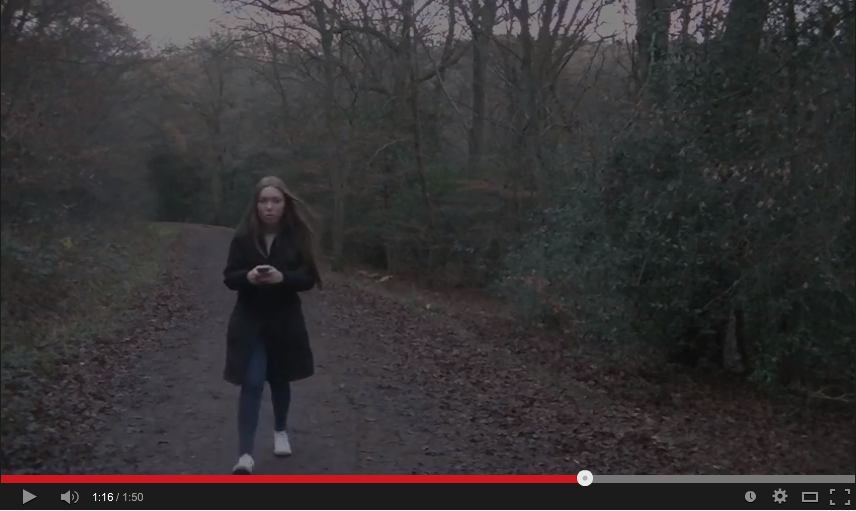
I even managed to include the victim convention which is that a female character should be in some sort of danger, the character I am referring to in the opening sequence is Cathryn, this is also seen in the inspiration I had for my film which was Halloween. The first person killed in Halloween is the girl inside of the house, in our film though we only see the antagonist approach the victim, this leaves the audience guessing what could've happened to her and like in Halloween, the girl is the first victim, and the antagonists intentions or motives remain a mystery in both my production as well as the Halloween opening sequence.
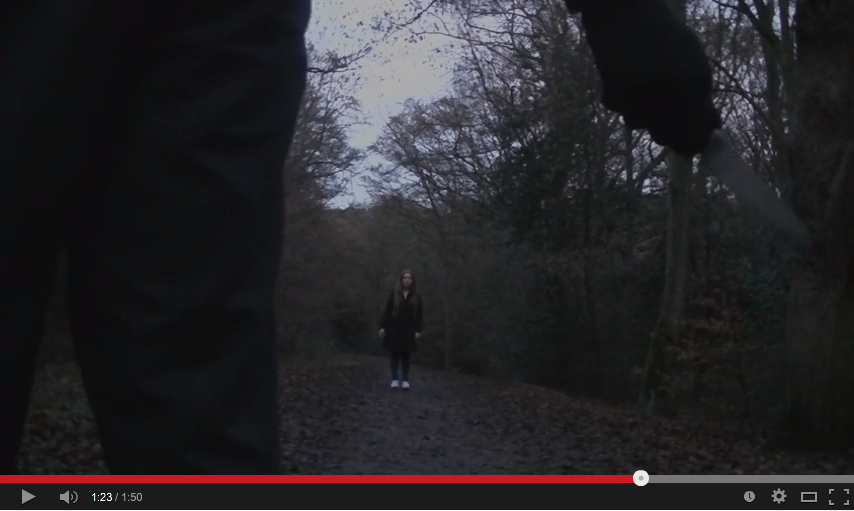
I incorporated the iconography of the knife, this can be seen in the film 'psycho' which is another inspiration I took from, as the murder weapon, I included it into my opening sequence as the murder weapon for the antagonist, he is seen holding it many times when he is in the frame, this can show he has violent intent for Cathryn throughout the opening sequence and this is seen right at the end when he approaches from behind her with a knife while she is hiding behind a tree in the forest, this creates suspense for the audience as they have no idea what has happened to Cathryn but they are also shocked at the fact that she may have been killed or captured, this builds a relationship between the character and the audience as they feel for her and are worried what could happen to her.

I managed to include the convention of a POV shot into the opening sequence, this was taken into effect as I needed a shot that would display the intensity of the scene, it makes the audience feel as if they're there, this further builds up a relationship between Cathryn and the audience as they really feel as if they're seeing things from her perspective, it puts the audience in the footsteps of Cathryn and this enables the audience to feel additional sympathy and allows the audience to keep building up a relationship with the audience. I took this inspiration from Halloween's opening sequence where most of the whole opening is done through a POV, however, in Halloween it's used to build up Enigma on who the audience are seeing the perspective of, much more differently than how we've done ours.
I included another convention in our opening sequence which was the colour and lighting being very dark throughout the majority of the opening sequence, this was mainly due to the fact that Halloween took place at night when there isn't many people around to help the victim, this was the same for our opening sequence as well because it's quite dark throughout the majority of our opening sequence and the colours are all dark and murky. The audience relate the lighting and colours to the films narrative and the dark themes that are embedded in to the film, this is conventional to the thriller genre and I took this inspiration from Halloween as said before.

One more convention I would like to refer to that I managed to implement was the style of the opening credits, for this I took inspiration from the film 'se7en' which featured the same kind of style, the se7en opening credits featured hand written text for the credits, my credits were near enough similar although ours seemed different as ours was a stencil like font so it seems more organised than the writing for 'se7en'. This is conventional as it can convey the mood and overall tone of the film or the film's antagonist as it may suggest the overall psyche of the antagonist.
I would say that my film defines the thriller genre successfully as I have managed to include many of the key conventions of a thriller. My film manages to build up the main convention of suspense, the main micro element that accomplished this was the soundtrack it was continuous throughout the opening sequence which built up suspense, but then the music would stop and the audience hear a different and louder noise which grabs the audiences attention therefore creating surprise for the audience. Another element that we used that defined the thriller genre was the cinematography when Cathryn sees the antagonist, a series of low angle shots are used, this makes him/her seem superior compared to Cathryn, therefore the audience build up a relationship for Cathryn as they feel empathy towards her. My film has incorporated many conventions that are found in different films in the thriller genre that were successful, the main inspiration for my opening sequence was 'se7en' as the credits itself are similar that they both look handwritten, this is conventional as the credits do not look normal, they are written roughly and the credits convey the twistedness of the character or the antagonist, both my film and 'se7en' use this convention. As said previously, my film has the convention of the antagonist possessing a hidden identity, this is also implemented in the film 'se7en' as you don't actually clearly see the antagonist until 3/4 into the film, this creates enigma for the audience which is conventional to the thriller genre.
The generic conventions for a thriller mean what you normally see in most thrillers, they don't necessarily have to be in all thrillers but are quite frequent and regular occurrences in the genre. A prime example can be the antagonists identity remains hidden throughout the film, this can be seen in most thrillers for example 'se7en' uses this convention throughout the film until the antagonist is finally revealed very suddenly. Another example of a convention is the other character that is just as important as the antagonist is the victim, most of time they are female victims that we see in peril, this can be seen in one of the inspirations for the thriller which was "Halloween" in which we see a woman stabbed to death by a mysterious killer in the opening sequence while the camera goes through the house in a POV shot.
Both of these conventions were used in my film's opening sequence, we use the generic convention of the mysterious antagonist in our film, as throughout the opening sequence you don't see the antagonist clearly and is portrayed to be bigger than the victim, the audience first see him watching him from the bushes somewhere in the forest and then see him standing opposite her further along the pathway, this also builds up enigma around the character for the audience as they want to know who it is, which is conventional to the thriller genre.
I even managed to include the victim convention which is that a female character should be in some sort of danger, the character I am referring to in the opening sequence is Cathryn, this is also seen in the inspiration I had for my film which was Halloween. The first person killed in Halloween is the girl inside of the house, in our film though we only see the antagonist approach the victim, this leaves the audience guessing what could've happened to her and like in Halloween, the girl is the first victim, and the antagonists intentions or motives remain a mystery in both my production as well as the Halloween opening sequence.
I incorporated the iconography of the knife, this can be seen in the film 'psycho' which is another inspiration I took from, as the murder weapon, I included it into my opening sequence as the murder weapon for the antagonist, he is seen holding it many times when he is in the frame, this can show he has violent intent for Cathryn throughout the opening sequence and this is seen right at the end when he approaches from behind her with a knife while she is hiding behind a tree in the forest, this creates suspense for the audience as they have no idea what has happened to Cathryn but they are also shocked at the fact that she may have been killed or captured, this builds a relationship between the character and the audience as they feel for her and are worried what could happen to her.
I managed to include the convention of a POV shot into the opening sequence, this was taken into effect as I needed a shot that would display the intensity of the scene, it makes the audience feel as if they're there, this further builds up a relationship between Cathryn and the audience as they really feel as if they're seeing things from her perspective, it puts the audience in the footsteps of Cathryn and this enables the audience to feel additional sympathy and allows the audience to keep building up a relationship with the audience. I took this inspiration from Halloween's opening sequence where most of the whole opening is done through a POV, however, in Halloween it's used to build up Enigma on who the audience are seeing the perspective of, much more differently than how we've done ours.
I included another convention in our opening sequence which was the colour and lighting being very dark throughout the majority of the opening sequence, this was mainly due to the fact that Halloween took place at night when there isn't many people around to help the victim, this was the same for our opening sequence as well because it's quite dark throughout the majority of our opening sequence and the colours are all dark and murky. The audience relate the lighting and colours to the films narrative and the dark themes that are embedded in to the film, this is conventional to the thriller genre and I took this inspiration from Halloween as said before.
One more convention I would like to refer to that I managed to implement was the style of the opening credits, for this I took inspiration from the film 'se7en' which featured the same kind of style, the se7en opening credits featured hand written text for the credits, my credits were near enough similar although ours seemed different as ours was a stencil like font so it seems more organised than the writing for 'se7en'. This is conventional as it can convey the mood and overall tone of the film or the film's antagonist as it may suggest the overall psyche of the antagonist.
I would say that my film defines the thriller genre successfully as I have managed to include many of the key conventions of a thriller. My film manages to build up the main convention of suspense, the main micro element that accomplished this was the soundtrack it was continuous throughout the opening sequence which built up suspense, but then the music would stop and the audience hear a different and louder noise which grabs the audiences attention therefore creating surprise for the audience. Another element that we used that defined the thriller genre was the cinematography when Cathryn sees the antagonist, a series of low angle shots are used, this makes him/her seem superior compared to Cathryn, therefore the audience build up a relationship for Cathryn as they feel empathy towards her. My film has incorporated many conventions that are found in different films in the thriller genre that were successful, the main inspiration for my opening sequence was 'se7en' as the credits itself are similar that they both look handwritten, this is conventional as the credits do not look normal, they are written roughly and the credits convey the twistedness of the character or the antagonist, both my film and 'se7en' use this convention. As said previously, my film has the convention of the antagonist possessing a hidden identity, this is also implemented in the film 'se7en' as you don't actually clearly see the antagonist until 3/4 into the film, this creates enigma for the audience which is conventional to the thriller genre.
Friday, 20 February 2015
Friday, 6 February 2015
Final group thriller
West Hatch High School - 16807
Charlie Stewart 9372
I also worked alongside
Jessica Day 9052
Ryan Samuels 9146
Sunday, 4 January 2015
Rough cut - Miss Georgiou
Audience feedback is very helpful when it comes to the making of a film as they can say what is good and where you need to improve on your film, this can lead to better ideas for the film and make it much more interesting to watch for the audience, it simply helps just to make it that small bit better.
All of the constructive feedback will be taken into account and we will improve on everything that is negative like editing the sound so it has more rhythm to the sequence, we will make sure to incorporate a lot more camera angles and movements to our piece that are in other thrillers and we also need to improve the lighting so that we can make sure the audience can see what is going on throughout our piece.
When we had finished our rough cut everyone watched ours to give us feedback on our thriller and to judge whether it was conventional and to see if our film showed a good understanding of these conventions that are used on most other thrillers, the teacher had also watched it to give us more feedback that will lead to our film looking better and much more professional, it can also lead to us deciding which shots stay and others that need to go.
This was a rough cut so we were expecting negative feedback. Our first feedback was that the music didn't seem edited well at all and sounded out of time and unorganized , this led to the audience not being engrossed into the film or the narrative of the film. Our next bit of feedback was very good as this was very easy to improve on and it was that we didn't have a wide range of camera movements and angles, so that was something that would require is to go back and improve on, but it showed that we didn't have a good understanding of thriller films and their conventions so this was something we need to improve on, it also seemed quite boring and slow paced. Our last bit of feedback was that the lighting was too dark at some points and was quite hard to see what was going on at some points, therefore taking the audience out of that immersion that we were trying to get them in.
However some of the feedback was not all constructive but instead it showed our group what we did well and if we could use some of our own work to improve on other bits of our work as well. Although as said before that the sound wasn't edited well, the music itself was good and managed to create the convention of suspense and tension within our film indicating that we had a good understanding of a thriller convention. Another positive comment was that the credit style seemed hand written and dysfunctional which is also another convention to the thriller genre as it can be related to the antagonist of the film as he is dysfunctional. Our last bit of positive feedback was that throughout the beginning sequence it built up suspense well which shows we understood the conventions of a thriller but i would also say that we need to make sure we capture the other elements like shock.
Thursday, 11 December 2014
Production Roles - Miss Miller
When you start making a film certain things need to be allocated between several people, if you leave every job to one person then they will rush everything which will make the film look bad and lower its success however if you make it so that many people take on different tasks then all the work is distributed equally between the production roles. The main production roles that are necessary when it comes to making a film are:
I said to the group that I wanted to direct the film as the storyboard I had made seemed conventional enough to the other members of the group. I had a good understanding of all the shots that i thought were necessary for our film and I knew we could get them done easily and quickly as long as everyone co operated. I managed to get all the shots done to a suitable standard and the rest of the group were also happy with what I had done. The reason the group wanted to do this was because I had a better understanding of the shots that we wanted to achieve
The actors for our group were very co operative but the level of acting could have been improved slightly. The one small problem we had was that some of the actors were not available for a lot so the first time we filmed we had to get their bits done first as that was a priority. Then one of our main actors couldn't do a lot of the filming as she couldn't for personal reasons so when we did have a chance to film we had to be quick because it got dark fast which made it hard for us to film. Having these people act was simple for us as everyone knew each other so it wasn't awkward for anyone at all.
Directors of photography was me and Ryan, Ryan wanted take charge for all the shots and i had just directed him on what to do. The reason we thought we should give it to Ryan was because he was enthusiastic about filming the sequence. Me and Ryan also work well together so he did a lot of what I asked him to do, he even came up with some suggestions for shots that could make it even more conventional to a thriller. The reason why we had two people work on this is because most of the time we need a second opinion on a shot so two people are adequate for this task.
Music producers was an easy one to get past as Ryan was very enthusiastic on getting us all suitable music for our thriller piece, he knew the websites he would look at so that is why we gave him that task to complete. The reason why we gave this task to only one person is because it is a task better left to one, if we had a few more working on it then they might go away and get the same music which would just be a waste of time and efficiency.
We agreed that Jess should be the screenplay writer as she had come up with the narrative of our opening sequence in the first place. Jess also had some ideas to change her narrative as did we but she took most of the control in that aspect. We only kept it to one person because the narrative may get complicated if we got three people to write it and we are meant to keep the narrative simple as it is only a beginning to a thriller.
MES coordinator we gave to Jess as well because when it came to the storyboards she was the one who had included the most iconography and a good use of lighting, she even had the idea of the characters positioning and what the differences meant, so we gave that task to her. The reason why we only had one person do this was because she knew the cast better than me or Ryan so she could ask them to bring the iconography that she wanted them to have.
And finally me and Jess decided to do the editing while Ryan would find us music. We both take it in turns to do the editing, Jess does most of the fonts as that was the key thing that she created in our planning opening credits, and I merge a lot of the clips together and cut them if they are too long or if something just isn't needed. The reason why we used two people is so that we can get a second opinion on how it looks and Ryan sometimes offers his which is very helpful. This makes editing easier for both of us as we do different things that maybe one of us is better at doing than the other and can do it quickly.
I think that nearly all roles were done to a suitable standard the only thing i may suggest could have been better is the casts acting as sometimes it seems too over the top or they even seem like they just want to go home so that do it quickly. Other than that I think everything else went well as we did the editing and Ryan found the music quite quickly so getting to editing was easy for us.
- producers - Jess, Ryan and Charlie
- Directors - Charlie
- Actors - Molly Van-Wijingaarden, Ryan Samuels, Morgan Boughey and Ella Sawtell
- Directors of photography - Ryan and Charlie
- Music producers - Ryan
- Screenplay writer - Jess
- MES co-ordinator - Jess
- Editors - Charlie and Jess
I said to the group that I wanted to direct the film as the storyboard I had made seemed conventional enough to the other members of the group. I had a good understanding of all the shots that i thought were necessary for our film and I knew we could get them done easily and quickly as long as everyone co operated. I managed to get all the shots done to a suitable standard and the rest of the group were also happy with what I had done. The reason the group wanted to do this was because I had a better understanding of the shots that we wanted to achieve
The actors for our group were very co operative but the level of acting could have been improved slightly. The one small problem we had was that some of the actors were not available for a lot so the first time we filmed we had to get their bits done first as that was a priority. Then one of our main actors couldn't do a lot of the filming as she couldn't for personal reasons so when we did have a chance to film we had to be quick because it got dark fast which made it hard for us to film. Having these people act was simple for us as everyone knew each other so it wasn't awkward for anyone at all.
Directors of photography was me and Ryan, Ryan wanted take charge for all the shots and i had just directed him on what to do. The reason we thought we should give it to Ryan was because he was enthusiastic about filming the sequence. Me and Ryan also work well together so he did a lot of what I asked him to do, he even came up with some suggestions for shots that could make it even more conventional to a thriller. The reason why we had two people work on this is because most of the time we need a second opinion on a shot so two people are adequate for this task.
Music producers was an easy one to get past as Ryan was very enthusiastic on getting us all suitable music for our thriller piece, he knew the websites he would look at so that is why we gave him that task to complete. The reason why we gave this task to only one person is because it is a task better left to one, if we had a few more working on it then they might go away and get the same music which would just be a waste of time and efficiency.
We agreed that Jess should be the screenplay writer as she had come up with the narrative of our opening sequence in the first place. Jess also had some ideas to change her narrative as did we but she took most of the control in that aspect. We only kept it to one person because the narrative may get complicated if we got three people to write it and we are meant to keep the narrative simple as it is only a beginning to a thriller.
MES coordinator we gave to Jess as well because when it came to the storyboards she was the one who had included the most iconography and a good use of lighting, she even had the idea of the characters positioning and what the differences meant, so we gave that task to her. The reason why we only had one person do this was because she knew the cast better than me or Ryan so she could ask them to bring the iconography that she wanted them to have.
And finally me and Jess decided to do the editing while Ryan would find us music. We both take it in turns to do the editing, Jess does most of the fonts as that was the key thing that she created in our planning opening credits, and I merge a lot of the clips together and cut them if they are too long or if something just isn't needed. The reason why we used two people is so that we can get a second opinion on how it looks and Ryan sometimes offers his which is very helpful. This makes editing easier for both of us as we do different things that maybe one of us is better at doing than the other and can do it quickly.
I think that nearly all roles were done to a suitable standard the only thing i may suggest could have been better is the casts acting as sometimes it seems too over the top or they even seem like they just want to go home so that do it quickly. Other than that I think everything else went well as we did the editing and Ryan found the music quite quickly so getting to editing was easy for us.
Monday, 8 December 2014
Filming Schedule - miss georgiou
A filming schedule is important to have because it lets the directors or creators know what shot is or will be next to create, it gives the creator a chance to make it in a chronological order so that when it comes to editing it is quite simple. The directors can also look back at the filming schedule to know what the next shot will be as they may forget all about it. As well as directors, the actors can look at the filming schedule to understand what they have to do when they are on camera.
We followed most of the schedule when filming, we followed the order of shots that were on the paper in the correct and chronological order of the schedule as it was easy to do and very convenient for us. We followed the use of MES to a high standard with the bags, phones and the knife for the antagonist. We went to the location that was listed and all personnel that were listed were utilized in each shot. The equipment we have followed because it makes it easier to use a tripod than holding it with your hands. The date and time we had changed a bit as for us it was quite hard for us to finish all our shots on that day so we had to keep going back.

We followed most of the schedule when filming, we followed the order of shots that were on the paper in the correct and chronological order of the schedule as it was easy to do and very convenient for us. We followed the use of MES to a high standard with the bags, phones and the knife for the antagonist. We went to the location that was listed and all personnel that were listed were utilized in each shot. The equipment we have followed because it makes it easier to use a tripod than holding it with your hands. The date and time we had changed a bit as for us it was quite hard for us to finish all our shots on that day so we had to keep going back.
Risk assessment - Miss Georgiou
Before filming we have to take the hazards into account as we may encounter one while filming and not have a clue what to do, however if we had created a risk assessment we could concur with the problem while filming. For example, if there is someone in the shot that is not meant to be in there and we accidentally forget to retake the shot, and then it comes to editing and find that that shot is the only one we have of it then we have to re shoot it which takes time, but if we had a risk assessment then we would know what to do and just stop them and say that we are doing a shot or filming a short sequence and then let them pass after we are done filming that specific shot. It's also good as it helps with planning as it lets us get over the more challenging obstacles that we may run into.

Tuesday, 2 December 2014
Group Storyboard - Miss Miller
Our group had all made a storyboard but now we all had to come together and decide what would be in the group storyboard that we would make for the actual shooting of the film. Our group decided that my one was the most conventional to a thriller so we made the group storyboard about my work but we incorporated Jessica's work in there as well. Ryan felt as if his work was not up to standard and didn't want to use it but he mentioned lots about sound so we kept that the same.
For the shots, we used mine as they agreed that I had a good idea of what I wanted to achieve or accomplish by the end of the filming, another reason we chose mine for the cinematography was because i made sure that the positioning of the antagonist would always be higher than Cathryn's positioning and we also used mine as the shots before the antagonist hits the scene are slow but after he makes himself present to Cathryn the shots we planned to have would be very quick thus creating a sense of panic in the sequence that element of being rushed puts the audience on edge.
As for setting or location and narrative description we used Jessica's storyboard for that as she has come up with and written a narrative for this sequence, so Jessica would have the best understanding of what would be happening between each individual shot. Me and Ryan would write and draw as she wanted them to be as it was her original story that we had made more conventional to a thriller.
For the soundtrack we used Ryan's storyboard as he was very detailed and very clear in his own storyboard so that when it came to the group one he was also very clear and precise on what he wanted for the soundtrack. Ryan had also stated that he would like to look into finding some interesting scores that we could then incorporate into our scene, he had even started looking for some before we had begun editing so sticking with his sound ideas throughout our piece will be good for our groups piece of work.
When it came to editing that was pretty much all of us as all edits in each frame were quite similar so we decided to use the ones that were more eerie or creepy as this would build up suspense for the audience. Me and Jess have offered to do the editing and Ryan will help when he has found the music to add to our scene so then he will edit it in. We also found that we had used quite a wide variety of edits in our storyboards to make it more of a thriller sequence, i would say our main inspiration would have to be se7en's opening credits sequence as this has a wide variety of edits as well as ours.
Another important element we were also similar to was the lighting as most thrillers have a good use of low key lighting in most sequences, we are trying to also add this into our sequence but we have found that it gets too dark too quickly at the moment so meeting up early is essential to making the film. The cameras will just have to be good enough for us to film because if they aren't then it might too hard for them to capture any footage.
For iconography we used Jessica's as she had much more than the rest of our group for iconography but there was one bit that we all had and that was the most important part which was the murder weapon, the knife. However the other props were needed as they would show just how helpless our character Cathryn is as she cannot defend herself with anything, which would make the audience feel more sympathy towards her, the group liked this use of iconography so we have planned to use it in our piece.
I think that this storyboard gives our group a lot of idea of what to film and how to film it. I think that we have managed to incorporate the best ideas into our piece that came from our groups storyboards and I also think that it is now more conventional than any of our own ones. If i had to change something it would probably be some of the cinematography but the group did say that most of it was conventional to a thriller so we stuck with it.

Monday, 1 December 2014
Opening scene Narration - Miss Miller
The scene begins with an eerie piece of music that connects well with the hand written credits. The shot is completely dark and then the credits introduce the production company in charge of funding the film and we are then taken to show who stars in the film as the main actors and actresses, then the directors are given their credits and this is where the audience find out where the sequence will be taking place as the black background with the hand written font in front will fade into a forest and slowly starts to emerge in the shot and will be low-key lighting. Then it introduces the title of the film for the audience that is "The Pathway" followed by this is the writer of the narrative of the film.
After this establishing shot of the forest we are then taken to an extreme long shot view of the group of girls with phones and bags as the iconography, they will be wearing casual clothes but they're brightly coloured as well, the lighting is quite bright and this lighting effect will be continuous throughout the rest of the sequence. While they are walking in the forest with the conventional forest sounds in the back ground the eerie music will die down now until you cannot hear it anymore. The camera stays on the girls but it fades to another shot of them walking up the forest, until they are all the way at the top, the girls then say good bye to one of their friends who then walks the rest of her way on her own, still with their bags and phones as the iconography. The camera then changes after to a shot of her walking away from the camera and we can that she is all alone. We then see a close up of her phone as she is walking still, the eerie music plays over the sound in the shot but the lighting is low-key again. The camera changes to a mid shot of her walking past and something snaps, she turns to see it but can't so she continues to walk. The camera then takes us to an over the shoulder shot of the killer wearing darker clothes than Cathryn and the angle is canted, the antagonist is positioned higher than her.
The next shot returns to Cathryn, who is texting on her phone, then looks up in shock at something in front of her. The eerie music from before is still going and lighting is the same as it was in the previous shot. The camera changes to an over the shoulder shot where we can see Cathryn is looking at a mysterious killer at the top of a hill in the forest. The antagonist is again positioned higher than her. It then cuts to a low angle shot of the antagonist but we cannot see his face therefore he is still mysterious. The shot then changes into a low angle where we can see Cathryn opposite the antagonist and as the antagonist lowers his right hand we see a knife in his hand, Cathryn then drops her phone in shock, the music still playing and the lighting is still the same, throughout this small encounter the edits are all linking shots of each other and the camera doesn't break the 180 rule.
The shot changes as the camera follows Cathryn in a panning style movement as she runs away from the killer, lighting is till the same and the music is still the same. We then cut a POV shot of Cathryn running with the sound of heavy breathing, she runs for a while until she gets to a tree, she then hides behind this tree in hopes she has escaped but the camera cuts back to a bit of distance from her as she peaks behind the tree, we see the killers knife slowly lower in the frame, he then slowly walks over towards her and as he is just about to reach her, the camera fades to black and that is where the opening sequence ends, after this scene it then follows Cathryn's narrative of how she may get out of the trouble she finds herself in.
The shot changes as the camera follows Cathryn in a panning style movement as she runs away from the killer, lighting is till the same and the music is still the same. We then cut a POV shot of Cathryn running with the sound of heavy breathing, she runs for a while until she gets to a tree, she then hides behind this tree in hopes she has escaped but the camera cuts back to a bit of distance from her as she peaks behind the tree, we see the killers knife slowly lower in the frame, he then slowly walks over towards her and as he is just about to reach her, the camera fades to black and that is where the opening sequence ends, after this scene it then follows Cathryn's narrative of how she may get out of the trouble she finds herself in.
Tuesday, 25 November 2014
Individual Storyboard - Miss Miller
Storyboards are very helpful when it comes to making a film as they give the creator or director a good idea of what they want to achieve when it comes to shooting their film. These should be made beforehand as these can be helpful later when it actually comes to making a shot as you can look back on these and quickly recreate the image that was in your mind prior to shooting.

We all, in our group of me, Ryan Samules and Jessica Day, had to go and make a storyboard individually. The reason we did this was because we needed to get our ideas down on paper as this would show how everyone is about the narrative of the film, because if someone didn't understand the narrative then they would be flustered when it came to the shooting of the film as they wouldn't understand what would be going on when we start filming.
For my storyboard I took inspiration from the film se7en as the films opening credits sequence was very dark and the writing that appears for the credits is also hand written or scratchy so that was something I took inspiration from when making my storyboard. For most of my shots I kept them all quite long as this creates the conventional theme of suspense that are appropriate for the thriller genre and also I like to take inspiration from Kubrick as well with his thriller/horror film the shining as most of the shots in that film last for quite a long time.
Another element I have seemed to grab hold of was to use quite little use of sound but most of the time it is diegetic sound of the forest. The reason I would like only this sound as it gives the audience the perception that not much is happening as it is just a normal sound in that environment, which can be related to the incident later, the fact that there isn't any help around shows that in this area attacking is common, just like the sound of the forest when you are in a forest.
I think that my storyboard is good as I managed to capture a lot of the conventions that are typical in the thriller genre, I am pleased that I have managed to keep the pace slow and the first bit calm compared to the later scenes. I think my storyboard will be very helpful when it comes to our group creating the group storyboard, as the drawings were quite detailed of how it should be filmed later. If there were to be a change in my story board, it would have to be more frames as I felt a bit rushed at the end of the sequence trying to end it, so we will need quite a few more frames when it comes to the group storyboard.
Tuesday, 18 November 2014
Planning characters - Miss Miller
Characters in a film are used for plot conventions or to drive the plot forward, more importantly they're used for the audience to pay attention to someone or something within the plot that the audience can build a relationship with. When characters are performed well by the actors is makes the audience feel as if they are just watching real people react to these situations.
Cathryn is the opening sequence's victim, she is 16 and her background is that she is a student. Cathryn is stereotypical to the thriller genre as the audience get the feeling she is a victim as not much about her background suggests she is central to the plot also this is only an opening sequence, however the audience will sympathize with her as they know her fate. The audience establish a relationship for her because they feel sympathy towards her character and because she falls right into that criteria for our target audience as she is a teenager. The narrative will begin with her so it is quite important and also what will happen to her will be the major starting point of the narrative.
The antagonist has not got much to talk about, he is an antagonist which makes him conventional to a thriller and he is a male but the age is unknown and his background is also not known. As said before, his character is an antagonist and has all the different traits like a hidden identity, uncertain age, no idea of what he looks like. However the enigma behind the character is what the audience will relate to about him, they have no idea who he is so they suspect that it is somebody throughout the entirety of the movie, the audience then feel sensation of creepiness that the antagonist could anyone in the film, that he is always there. The antagonist is also essential to the plot because the is who the audience would focus on most, the fact that this character could be out there killing again.
In conclusion I think both characters display the conventions of a typical thriller well. The victim Cathryn should be who our audience feel for and relate to throughout the opening sequence. I think that the planning has been very good as it has given me a clearer understanding of what our characters are trying to portray in the opening sequence.
Cathryn is the opening sequence's victim, she is 16 and her background is that she is a student. Cathryn is stereotypical to the thriller genre as the audience get the feeling she is a victim as not much about her background suggests she is central to the plot also this is only an opening sequence, however the audience will sympathize with her as they know her fate. The audience establish a relationship for her because they feel sympathy towards her character and because she falls right into that criteria for our target audience as she is a teenager. The narrative will begin with her so it is quite important and also what will happen to her will be the major starting point of the narrative.
The antagonist has not got much to talk about, he is an antagonist which makes him conventional to a thriller and he is a male but the age is unknown and his background is also not known. As said before, his character is an antagonist and has all the different traits like a hidden identity, uncertain age, no idea of what he looks like. However the enigma behind the character is what the audience will relate to about him, they have no idea who he is so they suspect that it is somebody throughout the entirety of the movie, the audience then feel sensation of creepiness that the antagonist could anyone in the film, that he is always there. The antagonist is also essential to the plot because the is who the audience would focus on most, the fact that this character could be out there killing again.
In conclusion I think both characters display the conventions of a typical thriller well. The victim Cathryn should be who our audience feel for and relate to throughout the opening sequence. I think that the planning has been very good as it has given me a clearer understanding of what our characters are trying to portray in the opening sequence.
Monday, 17 November 2014
Planning opening credits - Miss Georgiou
Opening credits are important to a film because it lets the audience know who was part of the films creation and to let the audience know that are watching that film. They are also used to show the importance of some people during the film's production. Before we were instructed with the task of making our own opening credits we had to watch an example of a thrillers opening credits sequence, the film we watched was called "se7en" and the opening credits connote much about the films antagonist with only the credits to do so.
The main colors seen throughout the introduction were dark dull colors that sometimes had flashes of bright colors as well, the reason for this is because it shows how dysfunctional the colours are, the flashes of white connect well with the characters hands you can see throughout the beginning part as he doesn't seem friendly, the dark colours connote that the themes behind the film will be dark and depressing, this is conventional to a thriller and we will try to implement this to our film. The font of the writing is almost as if it has been hand written or even scratched in which can connote the unbalanced nature of the film's antagonist. The whole opening credits sequence creates enigma as you don't clearly see what he is doing or if he is planning to do something but it creates suspense as the music is very eerie to the degree that the audience thinks something will happen in any second. the order of appearance in the film goes in this order: production company, who made the film, main actors, title of film, other actors, casters, who did the music, who did the costumes, producers, writers then directors.

 This opening credits sequence was made by Jessica Day. Jessica has managed to capture the style of font that thrillers use for opening credits' sequences very well and does look as if it has been hand written poorly which really makes it look creepy which shows the antagonist is mentally unstable, this is conventional to the thriller genre. The majority of colors are dark which is conventional to a thriller as it suggests the dark nature of the film or the character himself. Jessica had manged to get the order right as well by starting with the company and then the title of the film, we haven't all agreed on main actors yet so there is still that to get to. There really isn't much to say about negative aspects of Jessica's opening credits.

The style we are going to work on without a doubt is Jessica's as the font is conventional to the thriller genre, the colors she has used are also conventional and she had managed to get the order that opening sequences right as well. The credits I hope we make for our opening sequence are going in this following order, production company or CM studios presents, then it should have the main actors or actresses of the film so Molly van Winegaarden then Ryan Samuels but not the characters names, these should appear after the production company's credit then it will be the title of the film the pathway, this way it doesn't look like a trailer. Shortly after that credit the title of the film should appear and stay on screen for a while in our case it will be "the pathway". Then the directors Charlie Stewart, Ryan Samuels after that it will say who wrote the story which is Jessica day, afterwards it will mention the less central actors in the film then it should end with director of photography. I think this order is more conventional to a thriller and we are taking a lot of inspiration from se7en and the fact that a trailer ends with the title, we have tried to avoid that by planning to put it near the start of the credits.
The main colors seen throughout the introduction were dark dull colors that sometimes had flashes of bright colors as well, the reason for this is because it shows how dysfunctional the colours are, the flashes of white connect well with the characters hands you can see throughout the beginning part as he doesn't seem friendly, the dark colours connote that the themes behind the film will be dark and depressing, this is conventional to a thriller and we will try to implement this to our film. The font of the writing is almost as if it has been hand written or even scratched in which can connote the unbalanced nature of the film's antagonist. The whole opening credits sequence creates enigma as you don't clearly see what he is doing or if he is planning to do something but it creates suspense as the music is very eerie to the degree that the audience thinks something will happen in any second. the order of appearance in the film goes in this order: production company, who made the film, main actors, title of film, other actors, casters, who did the music, who did the costumes, producers, writers then directors.
This was my opening credits sequence. The font was basic as I couldn't find one that I liked very much, but this font was good as it stands out from the background as both colors contrast with each other on my one, I made sure that dark colors were more present in the frame than the light colors as this makes the whole credit sequence feel more dark which can be related to the plot of the thriller, making this kind of style of credit sequence conventional to a thriller. I have followed the right order of the appearance that opening credits normally have by starting with the production company then leading to the main actors and then the title.
This opening credits sequence was made by Jessica Day. Jessica has managed to capture the style of font that thrillers use for opening credits' sequences very well and does look as if it has been hand written poorly which really makes it look creepy which shows the antagonist is mentally unstable, this is conventional to the thriller genre. The majority of colors are dark which is conventional to a thriller as it suggests the dark nature of the film or the character himself. Jessica had manged to get the order right as well by starting with the company and then the title of the film, we haven't all agreed on main actors yet so there is still that to get to. There really isn't much to say about negative aspects of Jessica's opening credits.
This is Ryan Samuels' work for an opening credits sequence. Ryan has manged to include the main colors in opening sequences for thrillers which is black and white but as you can see mostly black is present which is conventional to the thriller genre. Though Ryan managed to get the films title in he got the order wrong by starting with it, as he should have started with the production company for our film. Ryan's style for the credits isn't perfect either, as the font looks quite basic.
The style we are going to work on without a doubt is Jessica's as the font is conventional to the thriller genre, the colors she has used are also conventional and she had managed to get the order that opening sequences right as well. The credits I hope we make for our opening sequence are going in this following order, production company or CM studios presents, then it should have the main actors or actresses of the film so Molly van Winegaarden then Ryan Samuels but not the characters names, these should appear after the production company's credit then it will be the title of the film the pathway, this way it doesn't look like a trailer. Shortly after that credit the title of the film should appear and stay on screen for a while in our case it will be "the pathway". Then the directors Charlie Stewart, Ryan Samuels after that it will say who wrote the story which is Jessica day, afterwards it will mention the less central actors in the film then it should end with director of photography. I think this order is more conventional to a thriller and we are taking a lot of inspiration from se7en and the fact that a trailer ends with the title, we have tried to avoid that by planning to put it near the start of the credits.
Friday, 14 November 2014
Planning sound - Miss Miller
Sound is important in films because if we didn't have sound we wouldn't understand the narrative or why certain characters are doing specific things on screen. Planning the use of sound is very important because when you start filming and there is unwanted sound in the background then you have to have a plan before you start filming so you know not to do it until the unwanted sound is gone. It can also help push the narrative forward as said before but it can also be linked to the conventions that are typical to thrillers for example eerie music in the background is conventional to the thriller genre.
Silence
This will be used when the victim or Cathryn is walking home and as she leaves her friends to go home down a different path to them. There will be backgrounds sounds of the forest but there won't be any talking or any music talking over the shot. This technique builds up suspense for the audience which is conventional to the thriller genre, the silence connotes that Cathryn is completely isolated and alone which means there is no help nearby therefore the audience feel understanding towards her character as they can visualize being in this situation themselves.
Off screen
This will be implemented after the silence shot, so afterwards it will cut to her walking through the forest and there will be rustling in the bushes or leaves crunching but as we don't see it it is off screen sound. As said before it will be crunching of leaves in a footstep pattern so one after the other. A relationship is established between the character Cathryn and the audience as both do not see the sound so it is as if the audience are in the situation with her walking through the forest which builds up a relationship between the character and the audience.
Parallel
This means that the sound will go well with the images on screen, this will happen after Cathryn has seen the antagonist and her breathing will become heavy and scared. This will show the threat that the antagonist holds and that the audience should be scared for her, which is conventional to the thriller genre as the audience further build up a relationship with Cathryn as they see the predicament she is in.
Non - diegetic
This is when the sound in a film or movie that isn't in world that the film is set but the audience can hear, so background music or narration playing, this will be when all the girls are walking home it will be quite eerie music. This connotes that something bad will happen soon, or that someone is watching them, but most importantly it creates a divide with the audience and the characters almost as if the sound is suggesting that the audience know the characters are helpless and the audience have to watch it and not do anything. This creates and establishes a relationship between the audience and characters as the audience feel empathy towards them.
With the use of sound in our opening sequence, I think that the suspense it creates will be intensified, the scene will be better as the music will create that tense atmosphere that the other elements would not be able to portray. The sound should be good as we have planned to use it in a way that is conventional to a thriller. I feel as if the planning of the sound is incredibly useful because when it comes to editing this we will be able to find the music easily and edit it in to the sequence quickly as well.
Silence
This will be used when the victim or Cathryn is walking home and as she leaves her friends to go home down a different path to them. There will be backgrounds sounds of the forest but there won't be any talking or any music talking over the shot. This technique builds up suspense for the audience which is conventional to the thriller genre, the silence connotes that Cathryn is completely isolated and alone which means there is no help nearby therefore the audience feel understanding towards her character as they can visualize being in this situation themselves.
Off screen
This will be implemented after the silence shot, so afterwards it will cut to her walking through the forest and there will be rustling in the bushes or leaves crunching but as we don't see it it is off screen sound. As said before it will be crunching of leaves in a footstep pattern so one after the other. A relationship is established between the character Cathryn and the audience as both do not see the sound so it is as if the audience are in the situation with her walking through the forest which builds up a relationship between the character and the audience.
Parallel
This means that the sound will go well with the images on screen, this will happen after Cathryn has seen the antagonist and her breathing will become heavy and scared. This will show the threat that the antagonist holds and that the audience should be scared for her, which is conventional to the thriller genre as the audience further build up a relationship with Cathryn as they see the predicament she is in.
Non - diegetic
This is when the sound in a film or movie that isn't in world that the film is set but the audience can hear, so background music or narration playing, this will be when all the girls are walking home it will be quite eerie music. This connotes that something bad will happen soon, or that someone is watching them, but most importantly it creates a divide with the audience and the characters almost as if the sound is suggesting that the audience know the characters are helpless and the audience have to watch it and not do anything. This creates and establishes a relationship between the audience and characters as the audience feel empathy towards them.
With the use of sound in our opening sequence, I think that the suspense it creates will be intensified, the scene will be better as the music will create that tense atmosphere that the other elements would not be able to portray. The sound should be good as we have planned to use it in a way that is conventional to a thriller. I feel as if the planning of the sound is incredibly useful because when it comes to editing this we will be able to find the music easily and edit it in to the sequence quickly as well.
Tuesday, 11 November 2014
Planning Cinematography - Miss Miller
Cinematography is very important in films as it means that every image is part of cinematography and you cannot have a film without images. With cinematography also comes movements and angles that the camera is able to do which can convey the themes that the film is trying to delve into. Planning is essential because if you started filming a film without knowing what shots or angles or movements you want to do it turns the whole film into a mess and you don't really know what you going for in the first place.
The first movement to discuss is the hand help camera movement, it makes the frames look shaky, therefore making the entire scene seem disorientating or dysfunctional and it will be used in our piece when the antagonist strikes the victim or Cathryn. This type of movement is conventional to a thriller as they always want the audience to feel and immerse themselves into the scene, this then enables the audience to build a relationship with Cathryn as they are put in her perspective of the situation of not knowing what is going on around them.
The next movement or shot if you prefer will be a point of view shot and this will be when the victim is being dragged away by the antagonist through a thick ground of leaves in a forest, it is a point of view shot of her perspective. The effect we hope it creates is that the audience again are seeing on the same level as Cathryn is which further builds that relationship with the audience and the character as they see what she is going through and can almost see it through their own eyes as well. This is conventional to a thriller film as the creators always want you to see the danger and situation through the characters' eyes.
Next is an angle shot known as canted angle where the frame is twisted sideways at an angle, this will be used when the killer or antagonist has been seen by the victim while she walks through the forest. The effect of this should be that the character seems twisted and mentally unstable as the camera suggest all of this about his personality. This builds a relationship with the audience as right away they get an insight of him already as an antagonist and see he is not fully stable and they build a relationship of hate against him. This is conventional as in many thrillers the antagonist is always seen as twisted by the audience.
Another angle shot we want to create for the sequence is a high-angle shot of the girl walking through the forest on her own as she has just left her friends. This shot shows the inferiority of the character but also connotes that she is isolated and alone. In turn, this will then make the audience side and feel sympathy towards her which enables the audience to build this relationship between her and the audience. This is conventional to a thriller as the director always wants the audience to side with the victim and route for them.
Another angle that will be utilized in the sequence is an eye-level shot when she is walking through the forest on her own, most parts will just be about the girl on her own as this creates quite a calm atmosphere but also unsettling for the audience to watch. This shows that the audience are on the same level as her and that they understand her character and feel as if they are there with her walking through the forest. This builds up a relationship with the character on screen, therefore it is conventional in doing so.
Lastly is a low-angle shot of the antagonist after the girl has seen him after walking through the forest and it cuts to him. This shows that the antagonist is stronger and bigger than the girl and has more authority than her as well. the audience again build up that hate for this character but even they fear him like the victim, as they feel as if they are there, the killer poses a threat to both the audience and the characters or the audience think that the antagonist poses a threat to them. This is conventional as the director always wants the antagonist to seem big and fearful.
In conclusion, I think that our opening sequence will be effective as we have included the typical conventions of the thriller genre through the use of cinematography as well as creating emotions and feelings for the audience to feel for the characters through the use of cinematography as well. We aim to do this by building a relationship between the characters and the audience. I found this task very helpful as I now understand how to create effects and emotions instead of analyzing them and it helped me understand which shots and angles were more important in the opening than the others.
The first movement to discuss is the hand help camera movement, it makes the frames look shaky, therefore making the entire scene seem disorientating or dysfunctional and it will be used in our piece when the antagonist strikes the victim or Cathryn. This type of movement is conventional to a thriller as they always want the audience to feel and immerse themselves into the scene, this then enables the audience to build a relationship with Cathryn as they are put in her perspective of the situation of not knowing what is going on around them.
The next movement or shot if you prefer will be a point of view shot and this will be when the victim is being dragged away by the antagonist through a thick ground of leaves in a forest, it is a point of view shot of her perspective. The effect we hope it creates is that the audience again are seeing on the same level as Cathryn is which further builds that relationship with the audience and the character as they see what she is going through and can almost see it through their own eyes as well. This is conventional to a thriller film as the creators always want you to see the danger and situation through the characters' eyes.
Next is an angle shot known as canted angle where the frame is twisted sideways at an angle, this will be used when the killer or antagonist has been seen by the victim while she walks through the forest. The effect of this should be that the character seems twisted and mentally unstable as the camera suggest all of this about his personality. This builds a relationship with the audience as right away they get an insight of him already as an antagonist and see he is not fully stable and they build a relationship of hate against him. This is conventional as in many thrillers the antagonist is always seen as twisted by the audience.
Another angle shot we want to create for the sequence is a high-angle shot of the girl walking through the forest on her own as she has just left her friends. This shot shows the inferiority of the character but also connotes that she is isolated and alone. In turn, this will then make the audience side and feel sympathy towards her which enables the audience to build this relationship between her and the audience. This is conventional to a thriller as the director always wants the audience to side with the victim and route for them.
Another angle that will be utilized in the sequence is an eye-level shot when she is walking through the forest on her own, most parts will just be about the girl on her own as this creates quite a calm atmosphere but also unsettling for the audience to watch. This shows that the audience are on the same level as her and that they understand her character and feel as if they are there with her walking through the forest. This builds up a relationship with the character on screen, therefore it is conventional in doing so.
Lastly is a low-angle shot of the antagonist after the girl has seen him after walking through the forest and it cuts to him. This shows that the antagonist is stronger and bigger than the girl and has more authority than her as well. the audience again build up that hate for this character but even they fear him like the victim, as they feel as if they are there, the killer poses a threat to both the audience and the characters or the audience think that the antagonist poses a threat to them. This is conventional as the director always wants the antagonist to seem big and fearful.
In conclusion, I think that our opening sequence will be effective as we have included the typical conventions of the thriller genre through the use of cinematography as well as creating emotions and feelings for the audience to feel for the characters through the use of cinematography as well. We aim to do this by building a relationship between the characters and the audience. I found this task very helpful as I now understand how to create effects and emotions instead of analyzing them and it helped me understand which shots and angles were more important in the opening than the others.
Planning editing styles - Miss Georgiou
Editing is important in thrillers as the style a shot can change into another one is very important to a film as it can convey the conventions and mood of the sequence in the film. The editing can either build up suspense with slow editing or can increase the pace of the editing which will create tension and makes the scene seem very dysfunctional and all over the place which can convey the mood of the characters which engages the audience as they feel as if they are there and more involved.
The first example of an editing technique that we will adopt into our sequence is the timing of shots. The timing of shots will be quick after the victim or Cathryn has been hit by the antagonist. This creates the effect that the scene is dysfunctional and this then relates to characters on screen as both are dysfunctional as one of them is panicking and the other isn't mentally stable. The audience then understand the character is panicking for good reason, and so they build a relationship with her character as they feel sorry for her in the situation she has found herself in.
The next example of editing we want to include is a fade at the end of the opening sequence when the victim is taken away by the antagonist and is being dragged through the forest. The fade would portray the end of the sequence but would leave it ambiguous enough so that the audience keep watching as they are intrigued to find out where the victim is now. This is conventional to a thriller films opening sequence as they always leave some parts of the story a mystery for the audience. The audience can relate more to Cathryn as they also don't know where she is, almost as if they are suffering the same fate with her.
Slow editing will be used at the start of the opening sequence when it all the friends walking through the forest. This is conventional to an opening scene in a thriller as they always start calm so that it builds contrast later on in the same scene. The audience can relate to this as they are there with the characters from the beginning and are there at the end, so this emphasizes that they have built a relationship with the characters to the point where they feel as if they are on screen with them.
The next example of editing we want to include is a fade at the end of the opening sequence when the victim is taken away by the antagonist and is being dragged through the forest. The fade would portray the end of the sequence but would leave it ambiguous enough so that the audience keep watching as they are intrigued to find out where the victim is now. This is conventional to a thriller films opening sequence as they always leave some parts of the story a mystery for the audience. The audience can relate more to Cathryn as they also don't know where she is, almost as if they are suffering the same fate with her.
Slow editing will be used at the start of the opening sequence when it all the friends walking through the forest. This is conventional to an opening scene in a thriller as they always start calm so that it builds contrast later on in the same scene. The audience can relate to this as they are there with the characters from the beginning and are there at the end, so this emphasizes that they have built a relationship with the characters to the point where they feel as if they are on screen with them.
Subscribe to:
Posts (Atom)